Pedestal desk: drawers both sides and the workspace they create
 Save
A pedestal desk is a desk with drawer units built into both sides, creating a knee space in the middle. The storage sits inside the frame rather than as separate cabinets, which is why the design has stayed popular in both traditional and modern offices. This article explains how the pedestal structure works, what it offers compared to desks with add-on storage, and the working habits and room sizes that suit it best. You will find Deskstor a practical starting point for understanding desk types and making an informed choice.
Design and structure of the pedestal desk
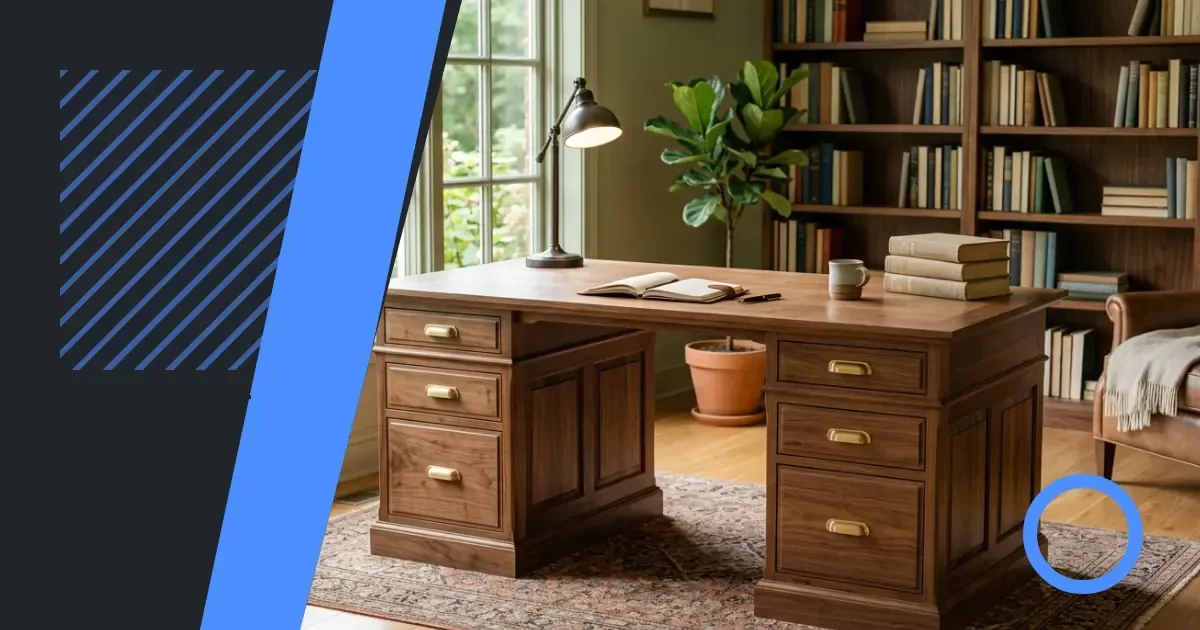
The pedestal desk takes its name from the two drawer units that support the worktop, one on each side. Each unit runs from floor to desktop height, forming a solid base. The knee space between them measures roughly 600 to 750 millimetres wide, enough for a chair to fit underneath. The worktop usually extends slightly beyond the front edge of the pedestals, creating an overhang that allows you to sit close without your knees hitting the drawers.
Traditional versions used solid wood throughout, with dovetailed drawers and brass handles. Modern pedestal desks use laminate, veneer or metal frames, often with lighter construction but the same basic layout. The drawers typically include shallow trays for stationery at the top and deeper file drawers below, though the exact configuration varies. Some models place locks on one or both pedestals.
The frame does not rely on legs; the pedestals themselves carry the weight. That makes the desk stable under load but also difficult to move once assembled. Worth noting: the fixed pedestals mean you cannot adjust the knee space width or swap the storage to one side only.
Storage capacity and drawer arrangement
A double pedestal desk gives you drawer storage on both sides without taking up additional floor space for separate filing cabinets. One side often holds shallow drawers for pens, paper and small tools, while the other houses deeper drawers for files or equipment. That separation keeps frequently used items within arm's reach and documents out of the way until needed.
The total number of drawers ranges from four to eight, depending on the desk's height and the depth of each drawer. A standard office pedestal desk might offer three drawers per side: two shallow and one deep. Home office versions sometimes replace one set of drawers with a cupboard or open shelf. File drawers usually accommodate A4 hanging folders, though not all models include the rails needed to suspend them.
In practice, the built-in layout means you cannot expand the storage later or rearrange it to suit changing needs. A desk with mobile pedestals or separate drawer units offers more flexibility, but the pedestal desk's fixed structure can be an advantage if you want a stable, self-contained workspace that does not shift over time.
Comparison with other desk and storage arrangements
| Arrangement | Storage location | Floor space | Flexibility |
|---|---|---|---|
| Pedestal desk | Built into both sides | Compact footprint | Fixed layout |
| Writing desk with mobile pedestals | Separate units on castors | Similar when positioned | Units can be moved or removed |
| Simple desk with wall storage | Shelves or cupboards above | Smallest floor area | Storage overhead, not beside |
| Desk with under-desk cabinet | One side only | Mid-range | One side clear for legroom |
The pedestal desk suits people who need substantial storage within immediate reach and prefer a traditional, enclosed workspace. It works less well if you plan to add equipment later, need frequent access to both legs of the desk for cable routing, or want the option to create an open, minimal setup. The fixed pedestals also make it harder to share the desk between users of different heights, since you cannot easily raise or lower the worktop without altering the entire structure.
Room size and placement considerations
A pedestal desk typically measures between 1,200 and 1,800 millimetres wide and 700 to 900 millimetres deep. Add the chair's clearance behind it and you need a space roughly 2,500 millimetres deep from the wall. The width depends on the desk model, but the depth is the critical dimension in small rooms. If your room is narrower than three metres, check that the desk leaves enough circulation space around it.
The desk's weight and size mean it usually stays in one position once placed. Choose a spot with natural light from the side rather than directly behind the screen, to reduce glare. If the room has a window on one wall only, position the desk so the light comes from your left if you are right-handed, or from your right if you are left-handed. That keeps your writing hand from casting a shadow across the page.
Pedestal desks work well against a wall or in the centre of a larger room, but the fixed knee space means you cannot push them into a corner and still sit comfortably. For very small rooms, a writing desk with wall-mounted storage or a compact computer desk may leave more floor space free. If you have the room and need the storage, the pedestal desk delivers both without requiring separate furniture.
Material and finish options
Solid wood remains the traditional choice, with oak, walnut and mahogany appearing in both antique and reproduction pieces. These desks are heavy, durable and often feature hand-finished details such as inlaid leather tops and turned handles. The weight makes them stable but also difficult to move between rooms.
Laminate and veneer desks offer a lighter, more affordable alternative. The pedestals use engineered board with a surface layer that mimics wood grain or plain colour. These models are easier to transport and assemble, and they resist scratches and moisture better than untreated solid wood. The drawers typically run on metal slides rather than wooden runners, which makes them smoother but can feel less substantial.
Metal-frame pedestal desks appear in industrial and modern office settings. The pedestals are steel, often powder-coated, with drawer fronts in matching metal or laminate. They are lighter than wood but still rigid, and the open leg design sometimes allows for easier cable routing than fully enclosed wooden pedestals.
Working habits that suit a pedestal desk
Paperwork and reference materials: If your work involves physical files, printed documents or reference books, the pedestal desk keeps them close without cluttering the worktop. One side can hold current projects, the other archives or supplies.
Fixed workstation: People who work in one place throughout the day benefit from the stable, enclosed feel. The pedestals create a defined workspace, which some find helps with concentration. The storage stays within reach, so you do not need to leave the desk to fetch tools or papers.
Multiple monitors or equipment: The wide worktop and solid structure support dual monitors, a printer or other equipment without wobbling. The deep drawers can house cables, external drives or spare peripherals. However, the enclosed pedestals make it harder to route cables neatly compared to desks with open legs or removable panels.
Shared or hot-desking environments: The pedestal desk is less suitable here. The storage is fixed to the desk, so personal items cannot be taken away easily. A desk with lockable mobile pedestals or no built-in storage at all works better when several people use the same workspace at different times.
Practical steps to assess whether a pedestal desk fits your needs
- Measure your room and mark the desk footprint on the floor. Use tape or a sheet to show where the desk will sit, then check you can move around it comfortably and open the drawers fully without hitting furniture or doors.
- List what you store now and estimate drawer depth required. A4 files need drawers at least 300 millimetres deep; stationery and cables fit in shallow trays. If most of your storage is digital or on wall shelves, the pedestals may go unused.
- Check the desk height against your chair and elbow position. Standard pedestal desks sit around 730 millimetres high. If that is too tall or too short for you, look for adjustable models or consider a different desk type, since the pedestals make height changes difficult.
- Consider how often you need to move or reconfigure the workspace. If you rearrange your room frequently or plan to add equipment later, a modular setup with separate storage may suit better. The pedestal desk is built for a fixed arrangement.
- Think about cable management and power access. Pedestal desks with enclosed sides offer fewer routes for cables than open-leg designs. Check whether the model has grommets or cutouts, or whether you will need to run cables around the outside.
Alternatives when a pedestal desk is too large or too rigid
If the pedestal desk's footprint or fixed layout does not suit, several alternatives offer similar storage or worktop space in different arrangements. A writing desk with mobile pedestals provides the same drawer capacity but allows you to move the storage units or remove them entirely when not needed. The pedestals sit on castors, so you can position them under the desk or beside it, and take them with you if you change rooms.
Wall-mounted storage with a simple desk keeps the floor clear and works well in small spaces. Overhead cupboards or open shelves hold files and supplies above the worktop, leaving legroom open on both sides. This setup suits people who need a clean, minimal desk surface and do not mind reaching up for stored items. For detailed guidance on fitting a desk into a tight space, read Fitting a desk in a small room: 6 placement ideas that preserve space.
A single-pedestal or cantilever desk places storage on one side only, leaving the other side open. This arrangement gives you some drawer capacity while keeping one leg clear for cables, a printer stand or simply more legroom. It is a middle ground between the pedestal desk's enclosed structure and the openness of a writing desk.
Maintenance and long-term durability
Solid wood pedestal desks last decades if the surface is treated and the drawers are kept aligned. Wipe spills immediately to prevent water staining the wood, and use coasters under mugs. Drawer runners should be checked annually; wooden runners benefit from a light application of wax, while metal slides may need tightening if they become loose.
Laminate and veneer desks require less maintenance but can be harder to repair if the surface chips or the edge banding lifts. Avoid dragging heavy objects across the top, and clean with a damp cloth rather than harsh chemicals. The engineered board inside the pedestals can sag under very heavy loads, so distribute weight evenly across drawers rather than overloading one side.
Metal-frame desks are the easiest to maintain. The powder coating resists scratches, and the drawers rarely need adjustment. Rust can appear if the coating is damaged and the desk sits in a damp room, so inspect any chips and touch them up with matching paint.
Antique pedestal desks often need restoration work: drawer bottoms may split, locks can seize, and leather inlays may crack or fade. These repairs are possible but require specialist skills. If you buy an older desk, factor in the cost and time of bringing it back to working condition.
Choosing between new, reproduction and antique pedestal desks
New pedestal desks offer modern finishes, factory warranties and precise sizing to fit current office layouts. They arrive flat-packed or pre-assembled, and customer service is available if parts are missing or damaged. The drawers glide smoothly and the worktop is factory-sealed, so the desk is ready to use immediately. However, new models sometimes use thinner materials and simpler joinery than older designs, which can affect long-term stability.
Reproduction desks mimic traditional styles using modern manufacturing. They look like antiques but cost less and require less maintenance. The finish is more uniform than genuine antiques, and the materials are chosen for durability rather than historical accuracy. This is a practical choice if you want the appearance of a classic desk without the restoration work.
Antique pedestal desks bring character and solid construction, often with features such as hand-cut dovetails, turned legs and original hardware. They are also heavier, more expensive and may need repairs before use. Condition varies widely, so inspect drawers, joints and the worktop carefully before buying. Provenance adds value but does not always reflect the desk's usability in a working office.
Good to know: antique desks were built for writing and paperwork, not computers. The knee space may be narrower than modern standards, and there will be no cable grommets or keyboard trays. If you plan to use the desk for computer work, measure the knee space and check whether you can add the equipment you need without altering the structure. For advice on setting up a comfortable working height, see Finding the Right Desk Height for Your Setup – Six Practical Steps.
Download PDF: Pedestal desk suitability checklist PDF, 27 KB
Further reading
Frequently asked questions
What makes a pedestal desk different from a regular desk with drawers added underneath?
The drawer units are built into the frame as load-bearing pedestals, not separate pieces. They support the worktop and form the desk's structure, so you cannot remove or reposition them.
How much storage does a double pedestal desk offer compared to a mobile filing cabinet placed beside a simple desk?
A double pedestal desk typically has four to eight drawers in total, similar to one or two mobile cabinets. The difference is that the storage is fixed in place and integrated into the desk's footprint, so it does not require extra floor space.
Can I adjust the height of a pedestal desk if it feels too tall or too low for comfortable working?
Most pedestal desks have a fixed height because the pedestals are built to a set size. Adjusting the worktop would mean altering the entire structure, which is rarely practical. If height adjustment is important, look for a desk with separate legs or a sit-stand mechanism instead.