Fitting a desk in a small room: 6 placement ideas that preserve space
 Save
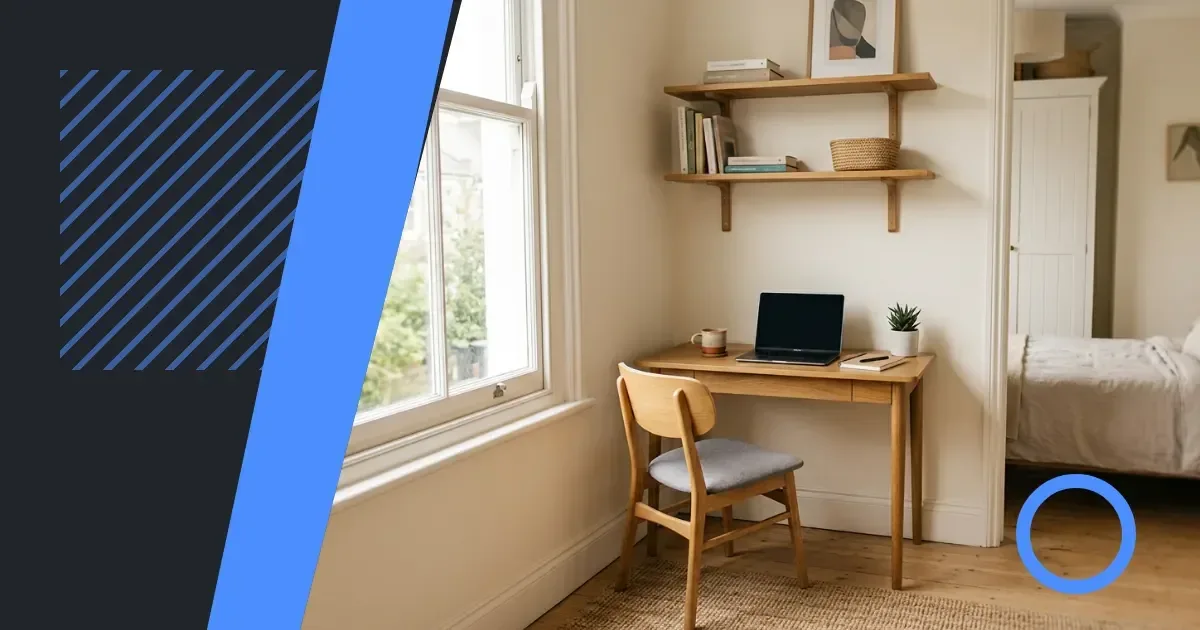
A desk fits in a small room when you choose the right shape and position it where it interrupts the least. The strategies below preserve walking routes and natural light while giving you a stable surface for work. Deskstor covers practical setups that suit rooms where every square metre counts.
Corner placement and what it frees up
A corner desk uses two walls that would otherwise sit empty. The L-shaped footprint keeps the centre of the room clear for movement, and you gain work surface on two sides without extending far into the floor area.
Position the desk so the longer side runs along the wall with fewer interruptions—no radiators or door swings cutting into the space. The shorter return sits against the perpendicular wall. This arrangement gives you separation between tasks: one side for a monitor and keyboard, the other for papers or a lamp.
Corner desks with a diagonal front edge take up slightly more floor space than square-cornered models, but they let you swivel between the two work zones without standing. Measure the diagonal dimension before buying; it dictates how far the desk projects into the room.
Wall-mounted surfaces and fold-down options
A wall-mounted desk has no legs on the floor. The surface attaches directly to the wall with brackets, leaving the area beneath it open. When the room doubles as a bedroom or sitting room, this setup avoids the bulk of a freestanding frame.
Fold-down desks hinge upward when not in use, reducing the projection to a few centimetres. The working height when lowered must align with a comfortable seated position—standard desk height sits around 73 centimetres, so measure before drilling the brackets. A fold-down surface needs support struts or a cable stay to hold the weight of a laptop and forearms; check the mechanism's weight capacity against what you plan to place on it.
Cable management becomes visible with wall-mounted desks. Run cables inside plastic trunking fixed to the wall, or use adhesive clips to guide them down to a floor socket without trailing across the surface.
Compact pedestal desks and single-drawer units
A pedestal desk consists of a flat top supported by drawer units at one or both ends. In a small room, a single-pedestal model—one set of drawers on one side, a simple leg on the other—offers storage without the width of a double-pedestal frame.
The drawer unit can be fixed or mobile. A mobile pedestal rolls on castors, letting you reposition it as a side table when the desk itself sits against a wall. Look for models with a brake on at least two wheels to prevent the unit drifting when you open a drawer.
Solid wood pedestal desks weigh more than laminate or metal-frame equivalents, which matters on upper floors or where you move furniture seasonally. Laminate tops resist moisture and scratches; solid wood shows character but needs treatment if a mug leaves a ring.
Positioning for natural light without glare
Place the desk perpendicular to a window rather than facing it or backing onto it. When you face the window, the screen reflects daylight and you squint. When your back is to the window, your body casts a shadow over the keyboard and papers.
A side-on position lets light reach the desk without hitting the monitor directly. If the room has one window and positioning the desk to the side blocks access or crowds the door, a sheer roller blind diffuses the light without darkening the room. Vertical blinds give you finer control over which slats admit light, useful when the sun tracks across the window during the afternoon.
In rooms where the window sits high on the wall, a writing desk—a simple table without bulky drawer stacks—fits beneath it without obstructing the opening mechanism. Overhead storage fixed above the desk must clear the window frame by enough to let the casement swing inward if it opens that way.
Adjustable-height and sit-stand frames in tight spaces
A sit-stand desk raises and lowers the work surface, letting you alternate between seated and standing positions. Manual models use a crank handle; electric versions have a motor and a control panel. Both need clearance above and below: the frame extends downward when lowered and the surface rises to around 120 centimetres when fully raised.
Check the minimum and maximum height against your own dimensions. When seated, your forearms should rest on the surface at a right angle; when standing, the same posture applies. A frame that bottoms out above your seated elbow height forces you to hunch; one that stops short of your standing elbow height offers no benefit in that position.
The base of a sit-stand frame usually forms a T-shape or a rectangular footprint. Measure it at the widest point of travel—some frames widen slightly as they rise. This footprint must fit within the floor space you have, with room for your chair to pull back when the desk is lowered.
Steps to plan the layout before moving furniture
- Measure the room's width and depth, noting where the door opens and which direction it swings.
- Mark the position of radiators, plug sockets and any built-in cupboards on a sketch or a photo.
- Measure the desk you intend to use—length, depth and height—and add 80 centimetres behind it for a chair that pulls out.
- Try the desk position on paper or with masking tape on the floor, checking that drawers and doors can open fully without hitting a wall or the bed.
- Walk the route from the door to the desk and from the desk to the window, ensuring no furniture forces you to turn sideways.
Storage above and beside the desk
Overhead cupboards or shelves recover the vertical space a small room offers. Fix them high enough that you will not strike your head when standing but low enough to reach without a step. A single shelf above the desk holds reference books or box files; two shelves give separation between active projects and archived papers.
Wall storage must go into solid masonry or a stud; plasterboard alone will not hold the weight of loaded shelves. Use appropriate fixings for the wall type and check the bracket's load rating against what you plan to store.
A narrow filing cabinet or drawer unit beside the desk keeps papers within reach. Choose a depth that matches or is slightly less than the desk depth, so the front edges align and the floor space reads as one zone rather than a staggered outline.
Desk shapes compared
| Shape | Floor area used | Surface area gained | Best position |
|---|---|---|---|
| Rectangular writing desk | Narrow depth, variable length | Single work zone | Against longest wall or under window |
| Corner desk | Two walls, diagonal footprint | Two linked zones | Room corner away from door |
| Wall-mounted fold-down | Minimal when raised | Limited to bracket span | Between fittings on any clear wall |
| Single-pedestal desk | Moderate, one-sided bulk | Storage integrated | Where drawer swing is unobstructed |
Cable routing and power access
A desk in a small room rarely sits next to the room's original power socket. Running an extension lead across the floor creates a trip hazard; running it along the skirting board and up the desk leg keeps it out of the walkway. Use adhesive cable clips at intervals to secure the lead.
Desks with integrated cable management—grommets in the surface or a trunking channel beneath—guide cables from devices to the socket without them draping across the work area. A grommet is a lined hole; feed cables through it and they drop straight down behind the desk. Trunking is a plastic or metal channel fixed to the underside of the desk or the back edge, holding multiple cables in a single route.
Check the socket's position relative to where the desk will stand. If the desk backs onto the socket, a standard plug may not fit between the desk and the wall; a flat or right-angled plug solves this. If the socket is further along the wall, measure the lead length of your equipment before assuming an extension will not be needed.
Stabilising a lightweight desk on carpet or uneven floors
A metal-frame or laminate desk on a carpeted floor can wobble when you lean on it. Adjustable feet on each leg let you level the frame by screwing one foot further out to compensate for an uneven surface. If the desk has fixed feet, slip a thin furniture pad or a cut square of hardboard under the short leg until the surface no longer rocks.
Desk mats protect carpet from chair castors and spread the load of the desk legs over a wider area. A polycarbonate mat with a smooth upper surface lets a chair roll freely; a fabric mat grips the chair but may bunch under repeated movement. Choose a mat large enough to extend beyond the desk footprint by the distance your chair travels when you push back.
Desks rated for dual monitors or heavy equipment list a weight capacity in the specifications. Exceeding it risks bending the frame or cracking a laminate top. If you plan to add a monitor arm—a bracket that clamps to the desk edge and holds a screen at an adjustable height—check that the desk edge is thick enough for the clamp and that the material will not compress under the pressure.
Download PDF: Small-room desk setup checklist PDF, 30 KB
Further reading
Frequently asked questions
What desk depth works in a room less than three metres wide?
A depth of 60 centimetres gives enough surface for a laptop and a notebook without extending far into the room. Add 80 centimetres behind the desk for a chair, leaving just over a metre for the rest of the floor space in a three-metre width.
Can you fit a corner desk in a small bedroom without blocking the wardrobe?
Yes, if the corner you choose is diagonal to the wardrobe door. Measure the swing of the wardrobe door fully open, then position the desk so its nearest edge stays outside that arc.
How much weight can a wall-mounted desk bracket hold when the desk is supporting a computer monitor?
Most brackets list a capacity between 20 and 40 kilograms when fixed into solid masonry. A monitor, keyboard and laptop together weigh around 8 to 12 kilograms, leaving margin for leaning on the surface.
Does a sit-stand desk need more floor space than a fixed-height desk of the same surface size?
The surface dimensions stay the same, but the base footprint of a sit-stand frame is often slightly larger to keep the desk stable at full height. Measure the frame's footprint, not just the top.
What is the best desk position if the room has two small windows on opposite walls?
Place the desk between the windows, perpendicular to both, so light reaches the work surface from either side without creating glare on a screen. This position also leaves the wall beneath each window free for storage or a chair.
Can a pedestal desk with drawers fit against a radiator without blocking heat output?
A gap of at least 10 centimetres between the desk back and the radiator allows air to circulate. If the desk must sit closer, choose a model with open legs rather than a solid back panel, or position the pedestal unit away from the radiator and use a simple leg on the radiator side.